

It’s not about goodness – it’s about righteousness.
A closer look at the effects of sin in relationship to the nature of God.
By John Soulliere
Have you ever heard either of these phrases or a version of them? “Well, I think I’m a pretty good person.” Or “I’m not really a bad person.”
If you have, it was most likely during a discussion about God or sin or heaven and hell, right? I sure have. And it got me thinking; is eternal “punishment” really necessary for all sin? And if so, why?
We know intuitively that some sins are more heinous and wicked than others, right? A “little white lie” doesn’t even come into a discussion anywhere near the level of child sex trafficking or adultery or murder. We inherently have a conscience that assigns a moral hierarchy between certain actions. In fact, our justice system recognizes this in dolling out sentences for crimes. But does God really care about the little, “harmless” sins most people would probably admit to? And is he “so harsh” as to “send me to hell” for those harmless, little sins? I’m not denying the problem with sin. Rather, I am wondering what it is about sin that is the problem.
I’m not denying the problem with sin… I am wondering what about sin is the problem.
What is the real problem with sin?
First, let’s clarify what sin is. In the Old and New Testaments, the words used for sin pretty much mean the same thing: to miss the mark. Think about an arrow hitting a bullseye. For you and me, it means that we would have to hit the moral bullseye – in thought, word and deed – every single moment of every single day to not “sin.” Further, the target, i.e. the bullseye, is none other than God moral standard – i.e. perfection. Therefore, to miss being as morally perfect as God himself is to miss the bullseye, AKA sin. Fine, I admit that I was disqualified many decades ago (see Romans 3:23, 1 John 1:10). Based upon this definition, it is impossible that anyone is free from sin.
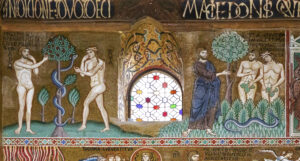
Now let’s go back to the original “miss” in Eden that resulted from the wayward arrow of Adam and Eve to see if we can glean any new insights from the oft-told story.
Here’s the setting: God had just finished creating the heavens and earth, nature and creatures, and all the things essential for a fulfilled and perfect existence. Then he capped it all off by making humans in his “image and likeness.” Then “God saw all that He had made, and behold, it was very good.” (Genesis 1:31 – emphasis added.)
Humans were not like the rest of creation – not the apes, dolphins, or dogs and cats. In fact, I find it a little amusing that just prior to taking Eve from Adam’s side, God “brought them (all the creatures) to the man to see what he would name them.” and “But for Adam there was not found a helper (intimate companion) fit for him.” (Genesis 2:19-20)
By the end of Genesis 2, it was clear that humans were uniquely created like God for the purpose of interaction and deep fellowship with God and one another. Adam and Eve were given life, purpose, relationship with the creation, with each other, and with their creator.
The question of knowledge.
It is also clear (in contrast to some pop-theology) that Adam and Eve already possessed certain kinds of knowledge. In the Hebrew language, there are numerous types of knowledge that get bundled up into one English word in our bibles. Part of the knowledge that Adam and Eve possessed was the ability to distinguishing between “right and wrong,” as clearly expressed by Eve in response to the representative of (or actually) Satan inviting her to defy God’s law (Gen 3:3). Additionally, by God tasking them to do certain things as well as not to do one certain thing – eat from the tree of the knowledge of good and evil – we see another type of knowledge.
It is important to remember at this point that the tree wasn’t the tree of all knowledge. I point this out because some have tried to misrepresent God’s intentions as wanting humans to be ignorant and compliant. The tree was of the knowledge of good and evil. The phrase translated “knowing (good and evil)” in Genesis 3:28 relates to “experiential (because it was an action), intimate, familiar knowledge” of the contrasting qualities of good and evil. A person can know about evil or even experience evil as an act against them. But that is different from intimate participation with evil that comes from their own willful action. This is the knowledge that God wanted them shielded from.
What really happened on that fateful day in Eden?
We don’t really know the timeline from the creation and the bifurcation of Adam into Adam and Eve, to the moment of the original sin. And we can’t say for sure how many times they met with God in the garden, or what they learned in the process prior to the fall. But we do know that God would manifest in some form to spend time with them in the garden (Gen 3:8) – and I don’t think they were just talking about the weather.
We also know that “Eden” was a special place, and that something about the rest of the world was somehow “untamed.” And we know that the first couple had been given the ability and authority to tame it. (Gen 1:27-28). Aside from these few chapters, we know little more about the first couple prior to the first transgression other than things were very good, peaceful, and there was harmony with God.
Before we complete our analyses of the “original” sin, I want to show you something in the New Testament (NT) that may help us to better understand what actually happened on that fateful day in Eden.
1 John 1:9 is a very well known, often-quoted verse in the NT – and for good reason! It is a promise of the ongoing and sustaining power of the atoning blood of Jesus on behalf of those who will, or have already, come to God through Christ. It is a promise of redemption to the lost, and a promise of restoration to God for his children as they turn to him in repentance for sin. But there is a little nugget of truth – a principle – that ties this verse back to the Garden and gives us some insight about what really occurred there.
The verse says, “If we confess our sins, He is faithful and righteous [or just] to forgive us our sins and to cleanse us from all unrighteousness” (1 John 1:9). Did you notice the last word in that verse? “Unrighteousness.” Unrighteousness is both an adjective, that is, descriptive of an act or intention, and a noun, that is, a condition – a state of being. An unrighteous act (lawlessness) leads to an unrighteous state of being. This is not to say that our righteousness, that is, our right standing before God in Christ, comes and goes based upon our moral perfection. But as we will see, it does affect our active communion or relationship with our heavenly father.
Unrighteousness is the opposite of righteousness. God is righteous by his very nature. His laws are an extension of His person. Unrighteousness (wrong-doing or lawlessness) is the antithesis of God’s nature. To participate in lawlessness is to participate in unrighteousness. To participate in unrighteousness is to know unrighteousness intimately – beyond simply intellectual knowledge. It is to allow that type of intimate knowledge to interact with the soul – even the soul of a believer.
Unrighteousness cannot exist in the presence of pure righteousness (God). Even as children of God under the righteousness of Christ, willful sin in our lives creates a relational “wedge” as it were. I am sure you all have experienced that sense of relational separation with both people and the Lord when you are making choices that are not in sync with your true, child-of-God identity. Choosing sin as a believer is also choosing relationship with sin over relationship with God. I am not talking about your position in Christ. I am talking about intimacy – and possibly, over time, complete rejection of your relationship with God.
While it is true that we are not perfect in this existence (mortal life), and as believers the atoning blood of Christ has been applied to our lives, it is also true that willful sin creates a relational rift between us and our heavenly Father – just like it did Adan and Eve. The difference is that when unrighteousness entered their souls, there was no permanent remedy for it – until Jesus. In his providence, God knew he would come in Christ to pay for their sin. He knew he would restore humanity to himself. This is why he took action immediately to cover their sin with the innocent blood of an animal – a shadow of things to come, and a Band-Aid on their current condition. He also gave the practice of animal sacrifice – the blood of the innocent for the guilty – as a temporary “covering” for sin in the Mosaic law.
The heart of the matter:
The problem with people who have not accepted God’s remedy for their sin (Christ) isn’t just about “doing something bad.” It is that the result of sin (even the little ones) has left them in an unreconciled state of unrighteousness that defines their very nature!
Upon death, this state of unrighteousness is locked in as a permanent condition of being contrary to the very nature of a holy God, hence, unable to exist in His presence. Unable! As the apostle Paul wrote to the church at Corinth, “For what do righteousness and wickedness have in common? Or what fellowship can light have with darkness?” (2 Corinthians 6:14) And if the disembodied, eternal person is unable to exist in God’s presence, they will go somewhere outside of His presence.
I recently read that since God is love, light, peace, joy, and every other good attribute, then being outside of that means outside of all of those things. No love, no peace, no light, no joy. Only an empty existence and the misery of regret – forever. I am not suggesting that is all there is to the afterlife of the unredeemed. The bible clearly teaches about varying post-death judgements. But we can’t get into that here. Suffice it to say, who would rationally want any of it?
Back to the garden.
While initially created like God, Adam and Eve, after unrighteousness entered their souls, were no longer like him; they no longer could commune or have fellowship with God as “same” beings. They were left in a contrary state to God’s very nature. They were to God like the beasts were to Adam – still part of the creation, but no longer “part of” or “a counterpart” to God. Now we understand a little better why their first reaction to God’s familiar presence in the garden was to hide in shame (Gen 3:8).
Unrighteousness without a remedy means being locked into a state of lawlessness, i.e. guilt and shame. You can’t undo running a red light by stopping at the next one. Neither can you undue unrighteousness by being “good.” Only perfect righteousness can pay the price for unrighteousness, hence, you, as already unrighteous, can never do it. No human could! And this is why from the very beginning God knew He would have to come in Christ Jesus to experience humanity, to reject sin, and to subject himself to the vile abuses of the unrighteous. He did it to make righteousness available to those very same unrighteous people who abused him. Because of His great love for us, the just one gave his life as a ransom for the unjust (1 Peter 3:18) – “the righteous for the unrighteous.” As Paul said, “that I may be found in Him, not having a righteousness of my own derived from the Law, but that which is through faith in Christ, the righteousness which comes from God on the basis of faith…” (Philippians 3:9).
Heaven and hell aren’t a simple question of “good and bad” people, or “little and big sins.” God isn’t sending anyone into judgement. Separation from God and judgement is the default of human existence ever since the fall of Adam. But God came in Christ as the remedy to this problem. The remedy for unrighteousness and separation from God is available to all, but many don’t want it.
The simple truth is that Adam and Eve are still alive in every one of their offspring – us. Outside of Christ their offspring (us) are still in a state of unresolved unrighteousness. People who reject God’s remedy are not only contrary to His nature, but they also remain hostile to God and unable to exist in His presence. It’s just like darkness not existing in the light.
And by the way, no one is a “victim” of Adam’s actions. Every person chooses to transgress God’s law and reject his remedy. Paul, quoting the Psalmist wrote, “there is no one righteous, not one… There is none that does good.” (Romans 3:10-18). And “all have sinned and fallen short of God’s glory,” that is, all are contrary to God’s very nature.
Being “good” or “not really that bad” cannot remedy unrighteousness! So next time someone tells you they “I live a good life” or “I’m not that bad,” make sure you tell them that it’s not a question of good or bad, but of righteous or unrighteous.
God is love. Love drove Him to both go through with the creation of humanity as well as to come in the form of a human to suffer at the hands of humans in order to pay for humanity to be with him. Whatever lies before us at the end of our mortal lives, it must be pretty awesome for God to care that much. This is the message of the Gospel. It’s not just about sin, but about the offer of our creator of a remedy to that sin so that we can return to intimacy with him – in this life and the life to come.

GET EMAIL UPDATES
Join our newsletter to get updates about upcoming events and new articles.
"*" indicates required fields